
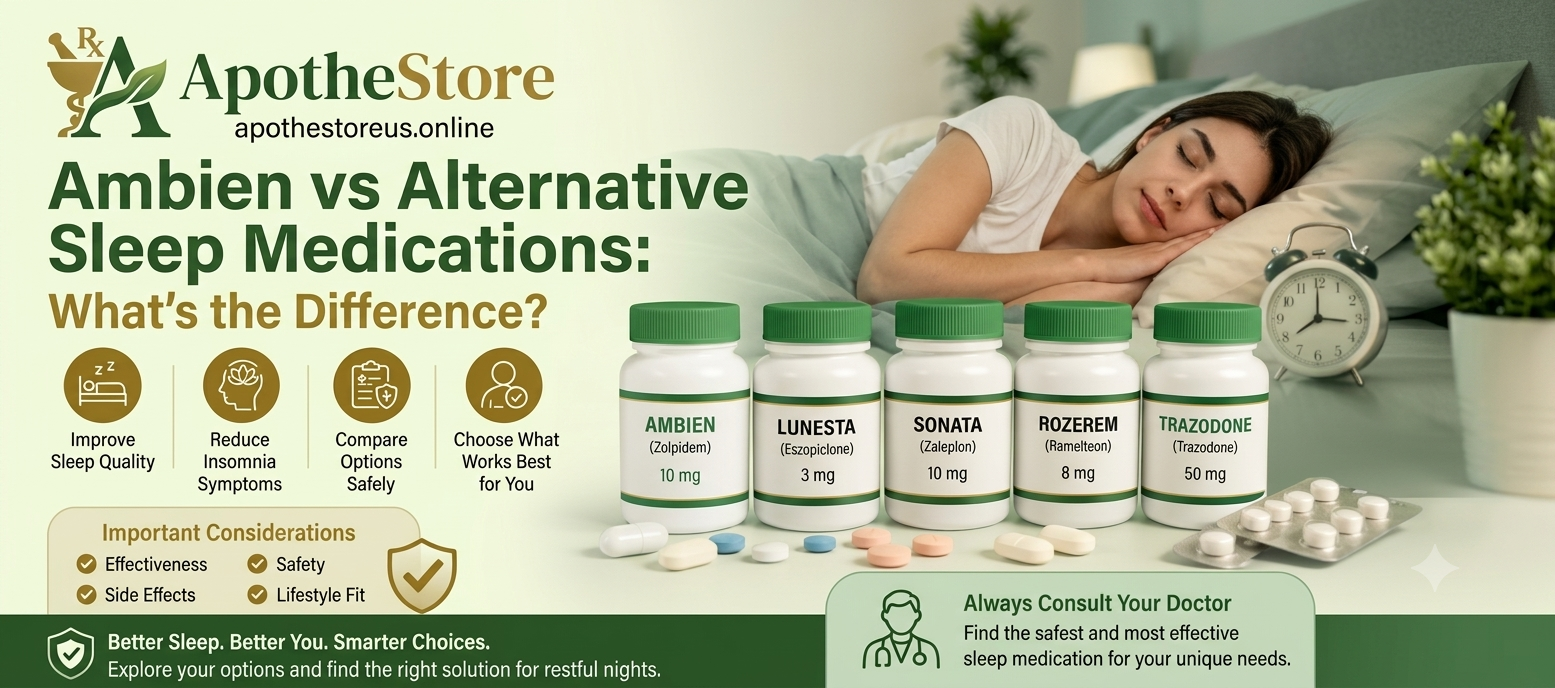
Ambien vs Alternative Sleep Medications: What’s the Difference?
Introduction
Trouble falling asleep or staying asleep can affect concentration, energy, mood, and everyday activities. When better sleep habits and behavioral approaches are not enough, healthcare professionals may consider medication as part of an insomnia treatment plan.
Ambien (zolpidem) is one prescription medication used for insomnia. However, it is not the only option. Other prescription medicines—including eszopiclone, zaleplon, ramelteon, doxepin, and orexin receptor antagonists such as suvorexant—work in different ways and may be considered for different sleep problems.
So, what is the difference between Ambien and alternative sleep medications? The answer depends on factors such as whether someone primarily has difficulty falling asleep, staying asleep, their other medications and health conditions, and potential side effects.
What Is Ambien?
Ambien is the brand name for zolpidem, a prescription sedative-hypnotic medication. The FDA-approved labeling describes Ambien as a treatment for short-term insomnia characterized by difficulty initiating sleep.
Zolpidem belongs to a group of medicines commonly referred to as benzodiazepine receptor agonists. Other medicines in this broad group include zaleplon and eszopiclone.
Ambien may help reduce the time it takes to fall asleep, but it is not appropriate for everyone. A healthcare professional should consider a person’s medical history, other medications, sleep pattern, and potential risks before prescribing it.
Why Consider Alternatives to Ambien?
People searching for Ambien alternatives may be looking for a medication with a different mechanism, a different duration of action, or an option that better matches their particular type of insomnia.
Importantly, there is no single sleep medication that is automatically “best” for everyone.
Prescription insomnia medicines can have different benefits and risks. Some are intended primarily to help with sleep onset, while others may be more relevant to difficulty maintaining sleep.
Common Alternatives to Ambien
1. Eszopiclone
Eszopiclone is another prescription sleep medication. Sleep guidelines have evaluated it for both sleep-onset and sleep-maintenance insomnia. Like zolpidem, it belongs to the benzodiazepine receptor agonist group.
Because eszopiclone and zolpidem have different pharmacologic characteristics, a clinician may consider individual factors when deciding whether either medication is appropriate.
2. Zaleplon
Zaleplon is another prescription medication used for insomnia. Clinical guidelines have considered it particularly for sleep-onset insomnia, meaning difficulty falling asleep.
Its place in treatment can therefore differ from medications that are primarily considered when staying asleep is the major concern.
3. Ramelteon
Ramelteon works differently from zolpidem. It is a melatonin receptor agonist and may be used for sleep-onset insomnia.
This difference in mechanism can be relevant when a healthcare professional is considering alternatives to traditional sedative-hypnotic medications.
4. Doxepin
Doxepin is another prescription option that may be considered for sleep-maintenance insomnia, or difficulty staying asleep. Sleep guidelines have evaluated low-dose doxepin for this purpose.
Doxepin is pharmacologically different from zolpidem, so it should not be viewed simply as a stronger or weaker version of Ambien.
5. Suvorexant
Suvorexant belongs to a different class called orexin receptor antagonists. It has been evaluated as a treatment for sleep-maintenance insomnia.
The different mechanism may make it a consideration for certain patients, but suitability depends on individual circumstances and medical history.
Ambien vs Alternative Sleep Medications: Key Differences
| Factor | Ambien (zolpidem) | Alternative medications |
|---|---|---|
| Drug class | Benzodiazepine receptor agonist | Several different classes |
| Main consideration | Sleep initiation; some formulations may address other insomnia patterns | Depends on the medication |
| Mechanism | Acts on specific brain receptors involved in sleep | Varies by medication |
| Examples | Zolpidem | Eszopiclone, zaleplon, ramelteon, doxepin, suvorexant |
| Duration/use | Product and formulation dependent | Varies considerably |
| Side effects | Can include daytime impairment and unusual sleep behaviors | Depends on the specific medicine |
| Prescription status | Prescription medication | Many are prescription medications |
The important point is that “Ambien vs alternative sleep medications” is not simply a competition between better and worse drugs. Each medication has its own indications, limitations, interactions, and safety considerations.
Safety Considerations With Ambien
Safety is one of the most important parts of any discussion about prescription sleep medicine.
The FDA has issued a boxed warning for zolpidem and certain other insomnia medicines because of rare but serious complex sleep behaviors, including sleepwalking and sleep driving while not fully awake. These events can result in serious injury or death.
FDA information also highlights the possibility of next-morning impairment, which can affect activities requiring alertness, including driving.
Anyone taking zolpidem should follow the prescribing instructions and discuss unexpected reactions or concerns with their healthcare professional.
Are Sleep Medications the First Treatment?
Medication is not always the first approach for long-term insomnia.
The National Heart, Lung, and Blood Institute notes that cognitive behavioral therapy for insomnia (CBT-I) is usually recommended as the first treatment option for long-term insomnia. CBT-I can include sleep education, relaxation techniques, stimulus control, and other behavioral strategies.
Healthy sleep habits can also support treatment. Maintaining a consistent sleep schedule, creating a comfortable sleep environment, limiting caffeine close to bedtime, and getting regular daytime physical activity may help improve sleep.
How to Choose Between Ambien and Alternatives
There is no universal answer to which sleep medication is best.
A healthcare professional may consider:
- Whether the main problem is falling asleep or staying asleep
- How long the sleep problem has been occurring
- Other prescription and over-the-counter medications
- Existing medical conditions
- Potential drug interactions
- Age and individual risk factors
- Previous experiences with sleep treatments
- Possible side effects
- Whether behavioral treatment such as CBT-I should be used
These factors are more useful than choosing a medication solely because it is marketed as a “strong” sleep aid.
Ambien Alternatives Are Not Automatically Safer
It is important not to assume that an alternative sleep medication is automatically safer simply because it is different from zolpidem.
Different medicines have different safety profiles. For example, NHLBI notes that prescription insomnia medicines can cause side effects, and some may cause unusual activities while asleep. Benzodiazepines can also cause dizziness, confusion, and muscle weakness and may be habit-forming.
For this reason, switching between prescription sleep medications should be discussed with a qualified healthcare professional rather than done independently.
Frequently Asked Questions
Is Ambien the same as zolpidem?
Yes. Ambien is a brand name for zolpidem.
What are common alternatives to Ambien?
Depending on the type of insomnia and individual circumstances, prescription alternatives may include eszopiclone, zaleplon, ramelteon, doxepin, and suvorexant.
Is Ambien better than other sleep medications?
Not necessarily. Different medications are designed or studied for different insomnia patterns, and the appropriate option depends on the individual.
Can insomnia be treated without medication?
Yes. CBT-I is generally recommended as a first treatment option for long-term insomnia, and healthy sleep habits can also be helpful.
Are sleep medications safe for everyone?
No. Prescription sleep medicines can have side effects, interactions, and contraindications. A healthcare professional should determine whether a particular medication is appropriate.
Can I switch from Ambien to another sleep medication myself?
It is better not to change prescription sleep treatment without speaking with your healthcare professional. The safest approach depends on the medication, dose, duration of use, and your individual health circumstances.
Conclusion
Ambien (zolpidem) is one of several prescription options for managing insomnia. Alternatives such as eszopiclone, zaleplon, ramelteon, doxepin, and suvorexant differ in their mechanisms and the types of sleep problems they may be used to address.
The right approach is not simply to ask which medication is strongest. Instead, treatment decisions should consider the specific sleep problem, medical history, other medications, potential side effects, and whether non-drug approaches such as CBT-I may be appropriate.
For persistent or worsening insomnia, speaking with a qualified healthcare professional can help identify the underlying problem and determine an appropriate treatment strategy.

Products Categories
-
 Buy Adderall Online
-
 Buy Adipex Online
-
 Buy Alprazolam Online
-
 Buy Ambien Online
-
 Buy Ativan Online
-
 Buy Carisoprodol Online
-
 Buy Clonazepam Online
-
 Buy Codeine Online
-
 Buy Darvocet Online
-
 Buy Demerol Online
-
 Buy Diazepam Online
-
 Buy Dilaudid Online
-
 Buy Fioricet Online
-
 Buy Hydrocodone Online
-
 Buy Hydromorphone Online
-
 Buy Lexapro Online
-
 Buy Lorazepam Online
-
 Buy Lorcet Online
-
 Buy Lortab Online
-
 Buy Meridia Online
-
 Buy Methadone Online
-
 Buy Norco Online
-
 Buy Opana ER Online
-
 Buy Oxycodone Online
-
 Buy Oxycontin Online
-
 Buy Percocet Online
-
 Buy Phentermine Online
-
 Buy Roxicodone Online
-
 Buy Soma Online
-
 Buy Suboxone Online
-
 Buy Subutex Online
-
 Buy Tramadol Online
-
 Buy Valium Online
-
 Buy Viagra Online
-
 Buy Vicodin Online
-
 Buy Vyvanse Online
-
 Buy Xanax Online





Leave a Reply